Sump Pump Failure Cleanup in Boston, MA
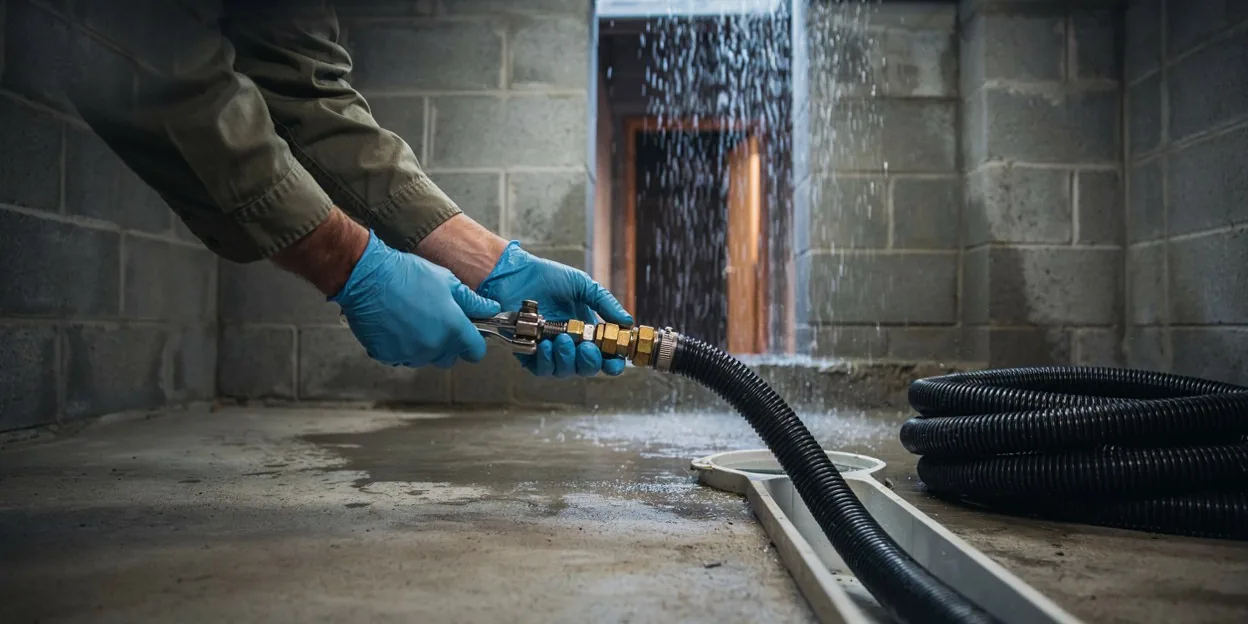
The power went out at two in the morning during the storm, and the pump that has kept the cellar dry for ten years went quiet with it. By the time the lights came back, the pit had overflowed, and the water was three inches deep across the finished basement. Call us now and tell us what you see. An independent local provider who handles sump pump failure cleanup in Boston and the inner-ring cities takes it from there.
What the crew does first
The crew gets the water off the floor with a pump and extractors, then meters the room. A sump failure fills a basement slowly and evenly, so the water reaches the bottom of every wall and every piece of furniture at the same time. The bottom of the drywall or paneling, the carpet pad, the baseboard, and the sill plate are checked, and the wet finishes are cut back to where the readings go dry.
Then the drying. Air movers and dehumidifiers go in by the readings, and the crew checks daily. Getting the pump running again is a plumber's or electrician's job, and it needs to happen before the drying can hold, because the next rain will do the same thing.
What to do in the next hour
Do not step into standing water if the electrical panel is in the basement and the water is near it. If the power is back, the pump may restart on its own; listen for it. If it does not, do not reach into the pit with the power on.
Move what you can carry up the stairs. Photograph the water line on the walls and the boxes sitting in the water before anything goes to the curb. Then call. Say whether the pump lost power, ran but could not keep up, or simply quit, and whether the water is still rising. That tells the crew and the plumber what they are walking into.
What is usually saved and what is not
Groundwater from a sump pit is usually clean enough to treat as a clean-water loss, so framing, subfloor, and concrete dry in place. Metal shelving, tools, and sealed bins are fine. Solid wood furniture that only got its feet wet is cleaned and dried.
Carpet pad, particleboard, cardboard, and upholstered furniture that sat in the water usually go. The bottom foot or two of drywall and the insulation behind it usually come out, since they wicked the water up. If the water came in through a floor drain or off the street, it is treated as contaminated and the job becomes basement flooding cleanup. Once the water is out, structural drying finishes it.
Suffolk County notes: pumps in old cellars
Sump pumps are common in the finished basements of Boston, Somerville, and Quincy because the fieldstone and brick foundations under those houses were never dry to begin with. The pump was added when someone finished the basement, and it has been running through every spring since. A pump that is ten or fifteen years old, a float switch that sticks, a check valve that fails, or a discharge line that froze at the outlet in February all lead to the same wet floor.
The storms that fill these cellars come in a pattern. Spring rain on frozen or saturated ground, snowmelt after a winter like 2015, and the nor'easters that knock out power for hours at a time. Houses near the Neponset in Hyde Park and Mattapan, along Alewife Brook in North Cambridge, and in the low streets of Medford and Malden along the Mystic and Malden rivers see the groundwater rise first. A battery backup or a water-powered backup pump is the fix for next time. Once the water is off the floor, the pump problem goes to a plumber and the drying stays with the cleanup crew; if the standing water is deep, the job starts with water extraction.
Many homeowner policies cover sump pump failure only with a rider, and groundwater seepage is often excluded. Ask the crew to record the cause, the water line, and the first readings so your adjuster has the facts.
Calling about sump pump failure cleanup
Say how deep the water is, whether the pump has power and whether it is running now, and whether the basement is finished. Mention a furnace or panel in the water, hardwood or carpet, and whether the water is still coming in. Call (857) 524-9927 now and tell us what you see.